
**Part 1: The question that revealed everything**
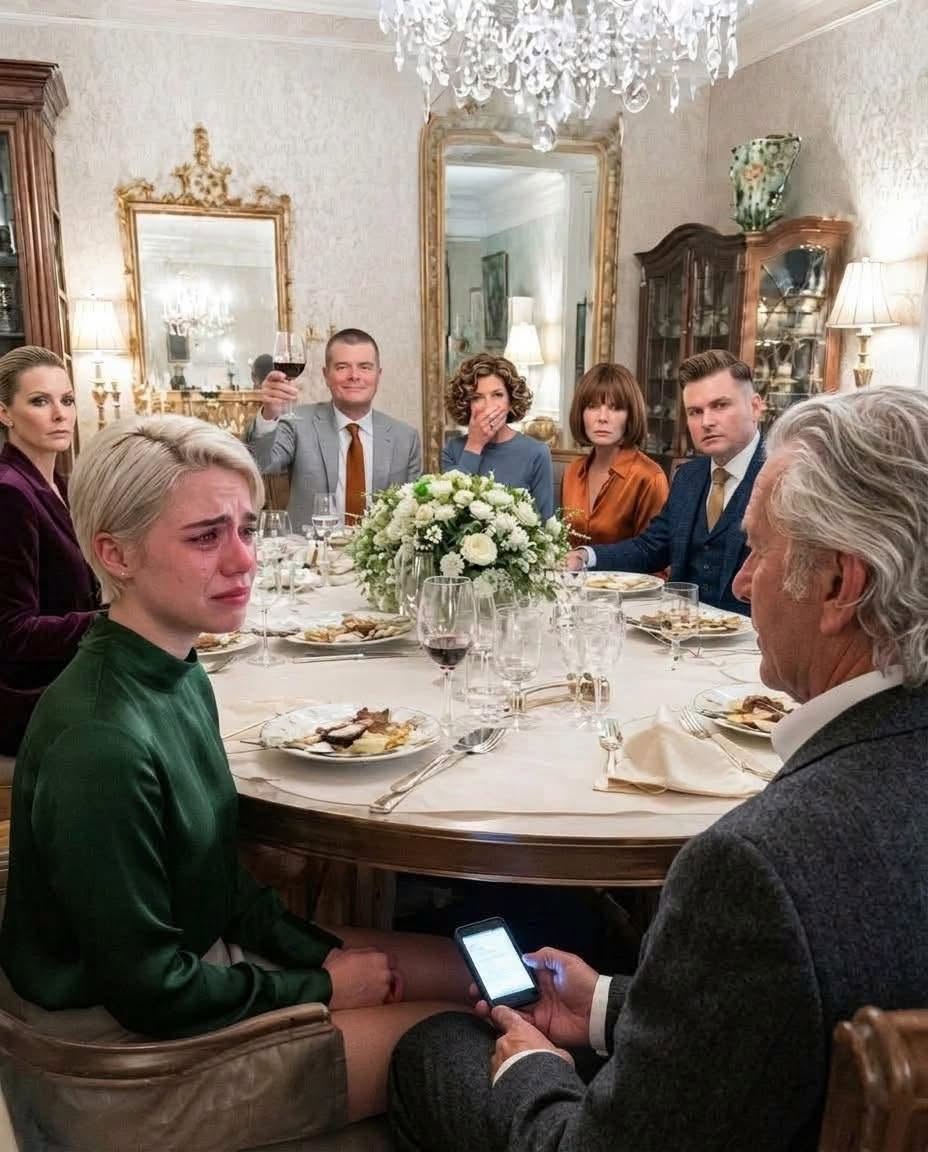
My father asked just one question, but he managed to silence the entire dining room.
—Why did you come by taxi, Jenna? Where’s the Honda Civic I gave you?
Patrick, my husband, was sitting across from me calmly cutting his steak, as if he hadn’t done anything wrong.
For three years, he had been translating his behavior into a kinder language.
When he teased me, I called it humor. When he criticized my spending, I called it budgeting. When I used my credit card without asking, I told myself that marriage required trust.
Most of the money went to his mother.
At first, Patrick claimed she needed help buying medication. Then came repairs, church donations, tires, gifts, and mysterious medical bills that I was never allowed to see.
Each request was supposed to be temporary.
Every question she asked was treated as an act of selfishness.
My father noticed the change in me long before I admitted it. He saw how I would check Patrick’s expression before speaking and how tense I became whenever money was mentioned.
But my father had a rule with his adult children.
He gave his advice once.
Then he waited.
Six months before that dinner, he gave me a silver Honda Civic.
It was practical, reliable, and safe—exactly the kind of gift my father would choose.
“This belongs to you,” she said as she handed me the keys. “Not to the family. Not to Patrick. To you.”
He also gave me a folder with the insurance, registration, and vehicle documents. A yellow note stuck to the cover said:
**Keep this on your desk, not in the glove compartment.**
At that moment, I thought I was just being overly cautious.
The car gave me back small fragments of independence.
I could drive to work without having to negotiate with Patrick. I could visit my parents or go to the supermarket without having to give explanations.
For the first time in years, I remembered what it felt like to be free.
Then Patrick started mentioning his mother.
At first, he said his car was old and embarrassing.
Then he said that I hardly ever used mine.
Finally, he turned it into a moral indictment.
—You’re watching an elderly woman struggle while you maintain a car you don’t even need.
I told him no.
He asked again.
I said no again.
By the third time, he no longer acted as if my answer mattered.
One Thursday night, I left work and discovered that the Civic was not in the parking lot.
For a moment, I thought it had been stolen.
I called Patrick repeatedly.
Six minutes later, he sent a message.
**Don’t start. Mom needed it. We’ll talk at home.**
He had taken the car while I was at work and given it to his mother.
I took a taxi home.
Patrick told me I was being dramatic and stated that many people survived without a car.
His mother sent a message:
Thank you for understanding the sacrifice.
But sacrifice is something one chooses.
I hadn’t chosen anything.
For almost two weeks, I didn’t tell anyone.
Instead, I started gathering evidence.
I saved Patrick’s messages, taxi receipts, credit card alerts, and a photograph of the empty parking space in front of my office.
I didn’t know exactly what I was preparing for.
All I knew was that Patrick had become very skilled at making me doubt my own memory.
By the night of my parents’ monthly family dinner, I was exhausted.
I arrived by taxi at 7:18.
Patrick was already seated at the table.
He didn’t seem guilty.
He looked comfortable.
My father watched me walk in. His eyes scanned my purse, my shoes, and then briefly flicked toward the driveway.
After I sat down, he asked where the Civic was.
I was going to lie.
She was ready to say she was in the workshop because protecting Patrick had become second nature.
But he answered first.
“I gave it to my mother,” he said. “She needed it more.”
He explained that his mother was ashamed of her old car and that I could use taxis.
The entire table froze.
Patrick spoke as if the vehicle belonged to him and he had generously decided how it should be used.
My father didn’t shout.
She looked at Patrick and gave a small, controlled smile.
“I understand,” he said.
Patrick relaxed immediately.
He thought he had won.
Then, from under the tablecloth, my father quietly took out his phone and sent a message.
—
**Part 2: The car that was never his**
Dinner continued, but the atmosphere had changed.
Patrick talked about business, investments, and important contacts, seemingly convinced that the awkward moment had passed.
Then his phone rang.
“She’s my mother,” he announced proudly.
He answered with a smile.
In a matter of seconds, the smile disappeared.
“Mom?” he said. “Calm down. What happened?”
Everyone watched as his face changed.
His shoulders tensed.
Then he said, “Don’t sign anything. Tell me you haven’t signed anything.”
My father’s phone vibrated.
He looked at the screen and turned it slightly towards me.
The photograph showed my Civic parked under the lights of a gas station near Patrick’s mother’s church.
A crane was in front. A man with a clipboard was talking to Patrick’s mother while she argued and waved her hand in the air.
At the top of the document on my father’s screen, the following words appeared:
**Hale Surgical Associates.**
That’s when I understood the folder.
My father had bought the Civic through an employee vehicle assistance program linked to his medical practice.
The car had been assigned exclusively to me, but the program maintained legal protections over the vehicle.
Patrick had no authority to give it away.
His mother had no authority to keep him.
The man next to the crane was not just any driver.
He was the fleet compliance manager for the medical group.
My father had contacted him from under the table.
Patrick put the phone down.
—Richard —she said nervously.
My father placed the knife and fork neatly together.
—You gave away a vehicle that didn’t belong to you.
Patrick tried to laugh.
—This is family.
My father nodded.
—That’s exactly why I asked you in front of the family.
Then he instructed Patrick to put his mother on speakerphone.
His furious voice filled the dining room.
He complained that someone was taking his car and that Patrick had promised him it belonged to him.
My father spoke calmly.
“Mrs. Collins, the Honda Civic was never Patrick’s to give to you. Give the keys to Mr. Alvarez and sign the release confirming that you received the vehicle without authorization. If you refuse, he will call the police.”
She stopped screaming immediately.
After several seconds, he said quietly, “Patrick told me Jenna agreed.”
Everyone at the table looked at me.
“I wasn’t,” I said.
My voice did not tremble.
Patrick turned angrily towards me.
—You could have helped my mother.
There it was again.
